
When Even "Home" Becomes Abstract :
Exploring the concept of Avtar Brah's "Diaspora Space" and how it dwells on borders, belonging, and cultural identity through a post-colonial theory lens.
Think about the last time you were eating at your favorite "ethnic" restaurant, indulging in a bowl of delicious Vietnamese pho soup or a bundle of Italian cannoli pastries. As you step out of the restaurant, you glance at how the neighborhood is lined up with businesses and storefronts plastered with signboards of a different language, immersed in an almost foreign enclave. Whether you realize it or not, you have experienced a modern product of post-colonialism, a Diaspora Space.
Who is Avtar Brah?
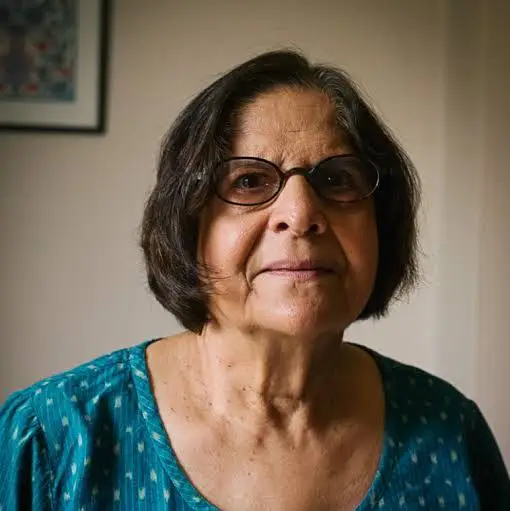
Avtar Brah, a sociologist professor at Birbeck, University of London, provided a theoretical framework to dissect the modern makeup of diaspora communities in the 21st century. Her 1996 book Cartographies of Diaspora: Contesting Identities more or less gave us a nuanced guide on how to think about migration, identity, and belonging. Through anecdotal experiences of her homeland of India being under the shadow of British Imperial rule and her later immigration to the UK, Brah analyzed how various immigrant communities form identities in their new country of residence. She was able to extract a theoretical framework coined by the term "Diaspora Space" that explains a postcolonial reality of globally displaced communities, neither rooted back to their homeland origins nor fully assimilated to their newly inhabited nations.
Conceptual Framework
Understanding that diaspora communities are formulated by various socio-political-economic factors rather than characterized as fixed and unchanged entities, there are three main components needed to produce this unique cultural territory. You need the "Diaspora", "Border Theory", and "Diaspora Space".
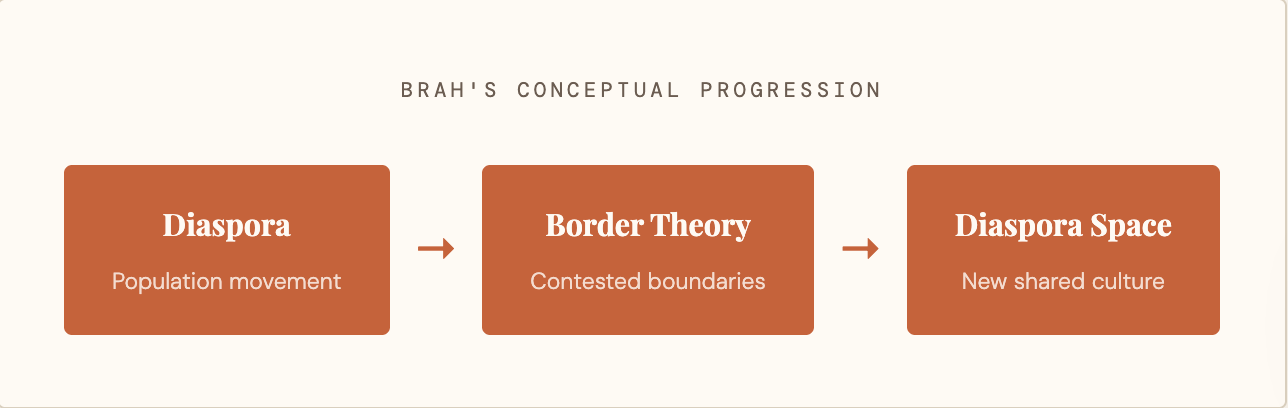
Step #1: "Diaspora"
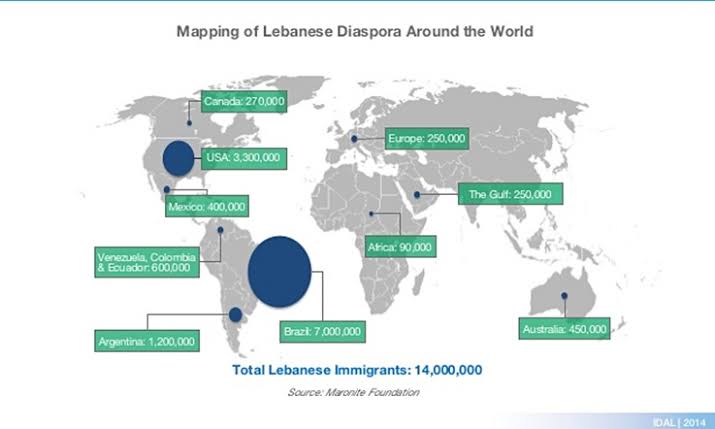
The term diaspora refers to the global locations in which people form permanent settlements that are not native to their original ancestral homeland. These communities become rooted in their new geographic locations and often have distinct cultural practices due to intermixing with the existing populations. A prime example of this occurs in the Lebanese diaspora, in which I adhere to. Globally, there is a greater population of Lebanese born and living abroad (14 million) than in Lebanon (6 million). Many factors, including war and conflict such as the Lebanese civil war in the 70s forced a mass exodus of the population toward immigration to Australia, France, Brazil, and North America. Brah conveys how the West African Diaspora in the Caribbean is truly sizable but is rooted in horrific circumstances in the transatlantic slave trade. She goes on to explain that the concept of diaspora should be understood in terms of historically contingent 'genealogies' in the Foucauldian sense (Brah 2). In essence, stating that diasporas form out of historical contexts not in random occurrences.
Step #2: "Border Theory"
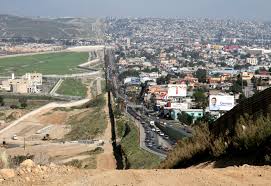
Border Theory explains the interchangeable qualities between metaphorical social constructs and the physical boundary nature of geographic borders. The social construct aspect lies in the fact that borders on maps are often drawn due to political implications to separate conflicts of interest. However, this "us vs them" mentality does not separate various cultural, ethnic, and racial distinctions naturally, thus one can argue borders are not real. As Brah explains, "this border typifies contemporary migration conditions: "The USA/Mexico border typifies the conditions of contemporary migrancy"(Brah 18). This is a clear example of Border Theory, as the US-Mexico border reflects a natural geographic separation along the Rio Grande River. It also socially marks the line between the developed and the non-developed world. One can highlight a clear contradiction in this social construct: migration laws criminalize the transfer of population between the two countries, yet cheap Mexican labor is imported to meet American economic demands.
Step #3: "Diaspora Space"

Diaspora Space is the end result of the diaspora population interacting with the native population. Through generations of coexistence, these multiple differing identities intersect to form new customs and traditions that are not conventionally attributed to their ancestral makeup. A key characterization of a Diaspora Space is that not only do the immigrating populations change, but there is a mutual innovation of the native culture as well. A great example of this occurs in England, where a sizable influx of South Asian immigrants throughout the century has propelled Desi cuisine, such as various curries, as a staple of the English diet.
Diaspora Space of Everyday Life
You do not have to venture far outside the contemporary pop culture scene to see Brah's ideas playing out in real time. Think about Latin pop star Bad Bunny's performance at this year's Super Bowl, or the K-pop genre dominating global streaming charts. Although not physical enclaves, these are very well Diaspora Spaces, where the intersection of cultural identities produces new spheres of media and art. Going back to the South Asian diaspora in England example, a delicious introduction of cuisine has permeated the lives and plates of millions of natives. Over the course of the 20th century, a sizable influx of Indian & Pakistani immigrants transformed the British palate. Desi cuisine, such as various curries, spiced rice dishes, and naan, became not just tolerated but celebrated as a staple of English identity. To the extent that "Chicken tikka masala" has even been called a national dish. The Diaspora Space here is that shared kitchen, which neither eliminated original British dishes from the stomachs of its citizens, but rather added a list of new exotic flavors.
Post-colonialism Lens
To get a more comprehensive understanding of what Brah is doing, you need to situate her within the broader context of postcolonial theory. Postcolonialism theory in literature, in essence, is a deep dive into the lasting cultural, political, and sociological effects of European colonial rule until the mid 20th century. Instead of framing European rule as a historical time period that ended with the formal independence of various Asian and African nations, this theory sets a societal lens that examines implications that continue to shape the present trajectory of these areas. Notable thinkers and authors such as Frantz Fanon, Edward Said, and Homi Bhabha contemplated what colonialism produced in terms of those affected. Such as how it polarized the world into a "civilized" and "primitive" binary. Brah adds to this discussion by shifting the goalpost to understanding what happens to those who move away from their colonized boundaries, escaping both binaries. At the end of the day, colonialism was not only about occupying land or extracting geographic resources, but it was also about human resources. The forcible transportation of enslaved Africans across the Atlantic to the "New World" saw generations of families uprooted and forced into new realities. Could you blame the waves of immigration toward the imperial metropole in search of economic opportunities, considering the fact that the same metropole colonialism had deprived these opportunities from their home countries? Ultimately, the diaspora is a forceful, not choiceful, consequence of colonial history. Rather than framing the issue of migrant communities as a political policy between nativism and multiculturalism, as many Western countries do, Brah reinforces the concept of a Diaspora Space as a purely postcolonial consequence. As Brah argues, diaspora should be understood in terms that diasporas are not random scatterings of voluntary migration, but formations with traceable roots along various historical realities, as cited by the French philosopher Micheal Foucault's concept of historical genealogy. Brah's postcolonial positioning is further exemplified when she contrasts the "homing desire" with the "myth of return." This marks a clear distinction between a displaced population's psychological yearning to feel at home and the fantasy of returning to an uncolonized homeland, which she argues is a myth. The extent of change in the homeland as well as the migrant has reached a threshold of no return, manifesting new cultural identities. In this way, Diaspora Space becomes a form of resistance against colonialism, not through direct kinetic actions of force but through the perseverance of a new form of cultural creativity of a population that was never supposed to conform.
Brah, Avtar. Cartographies of Diaspora: Contesting Identities. Routledge, 1996.
